Whether you are looking to boost recovery, support brain function, or optimize your overall wellness, chances are you’ve heard the buzz about peptides.
Peptides are short chains of amino acids that act as molecular messengers in your body, telling your cells exactly what to do. But here’s the catch: not all peptides are created equal, and how you take them matters just as much as what you take!
To ensure patient safety and clinical efficacy, regulatory bodies like the U.S. Department of Health and Human Services (HHS) have established specific rules regarding the allowable forms and routes of administration for compounded peptides under Section 503A policies. Let’s break down key peptides, how they work, the HHS-permitted ways to use them, and essential clinical considerations for optimizing your protocol.
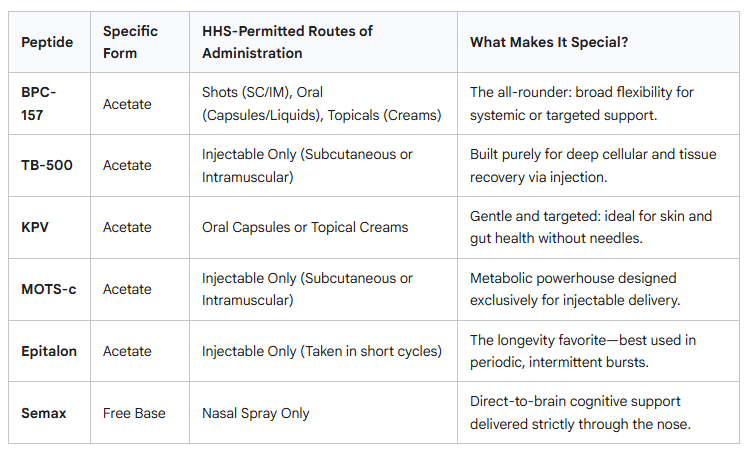
Quick-Glance Peptide Cheat Sheet
A Closer Look at Your Favorite Peptides
1. BPC-157: The Ultimate All-Rounder
Known widely as a recovery favorite, BPC-157 (in its acetate salt form) offers some of the most versatile administration options recognized by regulatory guidelines.
- How you take it: Subcutaneous or intramuscular injections, oral capsules, or topical creams.
- Why the variety? Depending on whether you’re targeting localized joint health, gut recovery, or general tissue support, your healthcare provider can tailor the exact delivery method to match your goals.
2. TB-500: The Tissue Specialist
If BPC-157 is the flexible versatile option, TB-500 is the specialist.
- How you take it: Injectable only (subcutaneous or intramuscular).
- Why it matters: TB-500 requires direct systemic absorption to perform effectively. Swallowable pills or nasal sprays just won’t cut it—HHS guidelines limit this peptide strictly to injectable dosage forms.
3. KPV: Gut & Skin Harmony
KPV is a natural favorite for patients who want to avoid needles altogether.
- How you take it: Oral capsules or topical creams.
- Why it matters: Derived from naturally occurring hormones, KPV works best where it directly touches tissue—making it ideal for skin soothing (topicals) or gastrointestinal support (oral). Per HHS standards, injectable forms are not permitted.
4. MOTS-c: The Cellular Engine
Derived from your cell’s mitochondria, MOTS-c plays a huge role in metabolic balance and exercise performance.
- How you take it: Injectable only (subcutaneous or intramuscular).
- Why it matters: To stay stable and reach your metabolic pathways intact, MOTS-c must bypass the digestive tract completely via a quick injection.
5. Epitalon: The Longevity Reset
Epitalon is famous in the longevity space for its role in cellular health and telomere support.
- How you take it: Injectable only, taken in intermittent courses.
- Why it matters: Epitalon isn’t something you take every single day forever! To ensure safety and efficacy, HHS policies outline that Epitalon must be dispensed in short, periodic cycles rather than continuous ongoing regimens.
6. Semax: Fast Brain Focus
Semax is a well-known peptide for clarity, focus, and brain support.
- How you take it: Intranasal spray or drops only.
- Why it matters: Under HHS Section 503A peptide enforcement discretion policy guidelines, Semax is specifically required to be in its Free Base form and is limited strictly to intranasal use for safe and effective absorption.
Why Formulation & Delivery Standards Matter to You
When it comes to peptide therapy, precision and compliance are key! Here is why following HHS-permitted guidelines keeps you safe and optimizes your wellness journey:
- Maximum Bioavailability: Taking a peptide via an unapproved route (like swallowing a peptide that only works as an injection) means your body breaks it down before it ever reaches your bloodstream.
- Targeted Results: Matching the correct form—whether a nasal spray for brain health or a cream for skin—ensures active compounds go straight to where they are needed most.
- Comprehensive Biomarker Care: High-level peptide protocols (like MOTS-c and Ipamorelin) rely on cellular methylation. Evaluating B-vitamin levels protects your brain chemistry and prevents unwanted nutrient depletion.
- Regulatory Safety & Quality: Adhering to standards set by HHS and federal regulators ensures that compounding pharmacies prepare these peptides under strict standards for purity, chemical stability, and patient safety.
Ready to Explore Peptide Therapy?
Peptides offer incredible potential for recovery, energy, and longevity, but success starts with the right plan. Always consult with a qualified healthcare provider to determine which peptide, dosage, and delivery method is appropriate for your body’s unique needs!
Regulatory & Scientific References
- HHS Section 503A Peptide Enforcement Discretion Policy: HHS Appendix B Reference Guidance
- Methylation & Brain Chemistry Insights: Is Your Peptide Protocol Draining Your Brain Chemistry?